
Active and Passive Voice

Every sentence in English follows a voice—active or passive voice that dramatically influences how readers perceive your message. Understanding the distinction between active and passive voice can transform your writing from confusing to compelling, from wordy to concise, and from weak to powerful. Whether you’re writing academic papers, professional emails, or creative stories, mastering these grammatical structures gives you precise control over your communication.
What is Active Voice?
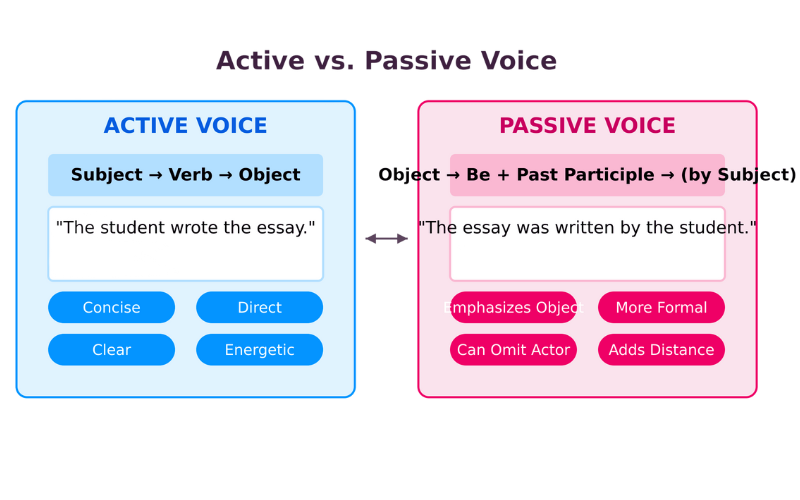
Active voice occurs when the subject of the sentence performs the action expressed by the verb. This creates a direct, clear relationship between the doer and the action.
Structure: Subject + Verb + Object
For example:
- The student wrote the essay.
- The professor graded the papers.
- The company launched a new product.
In each case, we immediately know who’s performing the action. The active voice typically creates more concise, dynamic, and straightforward sentences. According to the University of North Carolina Writing Center, active voice sentences are typically 2-3 words shorter than equivalent passive constructions.
Why Active Voice Matters
Active voice creates clarity by establishing a clear relationship between the subject and the action. When George Orwell advocated for straightforward writing in his essay “Politics and the English Language,” he specifically recommended active constructions for their precision and directness.
Writers like Ernest Hemingway became famous for their predominant use of active voice, which creates a sense of immediacy and engagement in their narratives.
What is Passive Voice?
Passive voice occurs when the subject of the sentence receives the action expressed by the verb. The focus shifts from the doer to what’s being done.
Structure: Object + To Be Verb + Past Participle (+ optional “by” phrase)
For example:
- The essay was written by the student.
- The papers were graded by the professor.
- A new product was launched by the company.
Without the “by” phrase, the actor can be completely omitted:
- The essay was written yesterday.
- The papers were graded late.
- A new product was launched last month.
The passive voice is perfectly grammatical, but changes the emphasis of the sentence.
Recognizing Passive Voice
You can identify passive voice by looking for these key elements:
- A form of the verb “to be” (is, are, was, were, am, be, been)
- A past participle (usually ending in -ed, -en, -t, -n)
- An optional “by” phrase indicating the actor
However, not all sentences with “to be” verbs are passive. For example, “She is beautiful” is active voice with a linking verb, not passive voice.
Key Differences Between Active and Passive Voice
| Aspect | Active Voice | Passive Voice |
|---|---|---|
| Sentence Structure | Subject → Verb → Object | Object → To Be Verb + Past Participle → (by Subject) |
| Focus | Emphasizes the doer | Emphasizes the receiver or action itself |
| Clarity | Usually more direct | Can be less direct |
| Conciseness | Typically more concise | Often wordier |
| Actor Visibility | Actor clearly identified | Actor may be omitted |
| Example | The dog chased the cat. | The cat was chased by the dog. |
| Word Count | Generally fewer words | Generally more words |
Common Misconceptions About Passive Voice
Many writers have been taught to avoid passive voice entirely, but this advice oversimplifies proper usage. Let’s address some common myths:
Myth 1: “Never Use Passive Voice”
The blanket prohibition against passive voice comes from writing advice that has been misinterpreted over time. Even William Strunk Jr. and E.B. White in “The Elements of Style” didn’t advocate for complete elimination—they advised using active voice as the primary construction while recognizing passive voice has its place.
Myth 2: “Any Sentence with ‘To Be’ Verbs is Passive”
This is perhaps the most common misconception. Sentences like “She is happy” or “They are running” contain forms of “to be” but are in the active voice. The passive voice specifically requires a past participle following the “to be” verb.
Myth 3: “Formal Writing Requires Passive Voice”
While passive voice has traditionally been common in academic and scientific writing, many modern style guides (including APA and Chicago) now encourage judicious use of active voice even in formal contexts. According to the APA Publication Manual, “Prefer the active voice…the passive voice is acceptable in expository writing and when you want to focus on the object or recipient of the action.”
When Active Voice Works Best
Active voice is particularly effective when:
- Clarity is essential: “The marketing team exceeded their targets” is clearer than “The targets were exceeded by the marketing team.”
- Space is limited: Active voice typically uses fewer words.
- Responsibility matters: “The company made a mistake” clearly assigns accountability compared to “A mistake was made.”
- Writing narratives: Active voice creates immediacy in storytelling.
When to Use Passive Voice Appropriately
Despite active voice being generally preferred, passive voice serves valuable purposes in specific contexts. Learning when to deploy passive voice intentionally can enhance your writing effectiveness.
Strategic Uses of Passive Voice
Passive voice is particularly effective when:
- The receiver of the action is more important: “The Declaration of Independence was signed in 1776” emphasizes the document rather than the signers.
- The actor is unknown or irrelevant: “My car was stolen” (when you don’t know who stole it).
- You want to avoid blame or direct accusation: “Mistakes were made” (in diplomatic contexts).
- The focus should be on the process or result: “The experiment was conducted under controlled conditions.”
- Creating an objective tone: “It is generally accepted that…” (in academic writing).
According to the Purdue Online Writing Lab, “In scientific writing, passive voice is often preferred in the Methods section, where the focus is on the procedure rather than on who performed it.
Passive Voice in Scientific and Academic Writing
The use of passive voice has traditionally been common in scientific literature, though this convention is evolving. The American Medical Association Manual of Style notes that “Use of the active voice is now acceptable in scientific writing, although the passive voice is still useful in certain situations.”
Consider these examples from published research:
Passive voice in methods section: “Samples were collected at three-hour intervals and were analyzed using mass spectrometry.”
Active voice in conclusions: “We found that temperature significantly affects reaction rates.”
The key is a purposeful selection of voice based on your communication goal.
How to Identify Passive Voice in Your Writing
Identifying passive constructions is the first step to controlling your use of voice. Here are reliable methods for spotting passive voice:
Key Indicators of Passive Construction
- Look for a form of “to be” + past participle: is conducted, was studied, were analyzed, etc.
- Check if the actor appears in a “by” phrase or is missing entirely
- Apply the “by zombies” test: If you can add “by zombies” after the verb and the sentence still makes grammatical sense, it’s likely passive. Example: “The report was written (by zombies)” works, so it’s passive.
Tools for Detecting Passive Voice
Various writing tools can help identify passive voice:
- Microsoft Word’s grammar checker
- Grammarly Premium
- Hemingway Editor
- ProWritingAid
However, these tools aren’t perfect—they may miss some passive constructions or flag active sentences as passive. Developing your own recognition skills is invaluable.
How to Convert Passive to Active Voice
Converting passive to active voice typically creates more direct, concise communication. Follow this process:
- Identify the actor: Who/what is performing the action? (Look for the “by” phrase or determine the actor from context)
- Make the actor the subject: Move the actor to the beginning of the sentence
- Change the verb form: Remove the “to be” verb and adjust the main verb accordingly
- Place the recipient of the action after the verb, as the direct object
Transformation Examples
| Passive Voice | Active Voice |
|---|---|
| The ball was thrown by John. | John threw the ball. |
| The proposal was approved by the committee. | The committee approved the proposal. |
| The data is being analyzed by our team. | Our team is analyzing the data. |
| The email had been sent before the deadline. | Someone had sent the email before the deadline. |
| Mistakes were made. | We made mistakes. |
| The song is performed by local artists. | Local artists perform the song. |
Sometimes, converting to active voice requires educated guesswork about the actor if it’s not specified in the passive construction. This can be a good exercise to determine if important information is missing from your writing.
Common Challenges in Conversion
Some passive constructions present special challenges:
- Unknown actors: When converting “The window was broken,” you might need to specify “Someone broke the window” or “Vandals broke the window.”
- Institutional actions: “You have been selected for an interview” becomes “The hiring committee selected you for an interview.”
- Complex verb forms: “The regulations could have been being implemented” becomes “The department could have been implementing the regulations.”
Impact on Different Writing Styles
Voice choice varies significantly across different contexts and professions. Understanding these conventions can help you make appropriate choices.
Academic Writing Considerations
Academic writing has traditionally favored passive voice for its perceived objectivity, but this is changing. Modern academic style guides now often recommend selective use of active voice:
- APA Style: Recommends active voice but acknowledges appropriate uses of passive
- MLA Style: Generally advocates for active voice when possible
- Chicago Manual of Style: Recommends active voice for clarity but recognizes passive voice as a legitimate stylistic tool
Dr. Helen Sword, in her research on academic writing, found that the most engaging academic authors use active voice for approximately 70-80% of their verbs.
Business Communication Best Practices
In business writing, active voice generally creates more impact:
- Emails: “I need your report by Friday” is clearer than “Your report is needed by Friday.”
- Marketing: “Our software saves you time” connects better than “Time is saved by our software.”
- Instructions: “Submit your application through the portal” is more direct than “Applications should be submitted through the portal.”
Technical Documentation Standards
Technical writing requires particular attention to voice:
- User manuals: “Click the icon” (active) vs. “The icon should be clicked” (passive)
- Process documentation: May use passive voice when focusing on the system rather than user actions
- Requirements: Often use passive voice (“The system shall be designed to…”)
According to the Microsoft Manual of Style, “Use active voice most of the time. Use passive voice when the action rather than the doer is the focus of the sentence.”
Creative Writing Applications
In fiction and creative nonfiction, voice choice affects pacing and emphasis:
- Action scenes: Active voice creates immediacy and energy
- Reflective passages: Passive voice can create a contemplative tone
- Character development: How a character uses voice can reveal personality traits
Novelist Stephen King advises in “On Writing” to “avoid passive voice” as a general rule, saying that “timid writers like passive verbs for the same reason timid lovers like passive partners.”
Voice Choice: A Powerful Writing Tool
Understanding the distinction between active and passive voice—and knowing when to use each—gives you precise control over your communication. Rather than viewing passive voice as inherently problematic, treat both voices as tools in your writing toolkit.
Remember these principles:
- Active voice generally creates more direct, concise communication
- Passive voice serves specific purposes when used intentionally
- Context and communication goals should guide your voice choice
- The best writers master both voices and use them strategically
By developing awareness of voice in your writing, you join a tradition of thoughtful communicators who craft their messages with precision and purpose.
Frequently Asked Questions About Active and Passive Voice
Is passive voice grammatically incorrect?
No, passive voice is not grammatically incorrect. It’s a legitimate grammatical construction in English and many other languages. The misconception that passive voice is “wrong” stems from style advice that has been oversimplified. Passive voice becomes problematic only when overused or used inappropriately, creating unnecessarily complex or vague sentences.
Does passive voice always make writing weak?
No, passive voice doesn’t inherently weaken writing. When used purposefully and in appropriate contexts, passive voice can be the most effective choice. For instance, in scientific writing when describing methodologies, passive voice appropriately shifts focus to the processes rather than the researchers. The key is intentional usage—passive voice becomes problematic when used habitually without purpose.
How does passive voice affect word count?
Passive voice constructions typically require more words than their active counterparts. For example:
-Active: “The committee approved the proposal.” (5 words)
-Passive: “The proposal was approved by the committee.” (7 words)
Can passive voice be more appropriate than active voice?
Absolutely. Passive voice is often the better choice when:
-The receiver of the action is more important than the doer
-The actor is unknown, irrelevant, or obvious
-You need to maintain an objective tone
-You want to emphasize the action itself rather than who performed it
-Discussing sensitive topics where assigning blame might be counterproductive

